
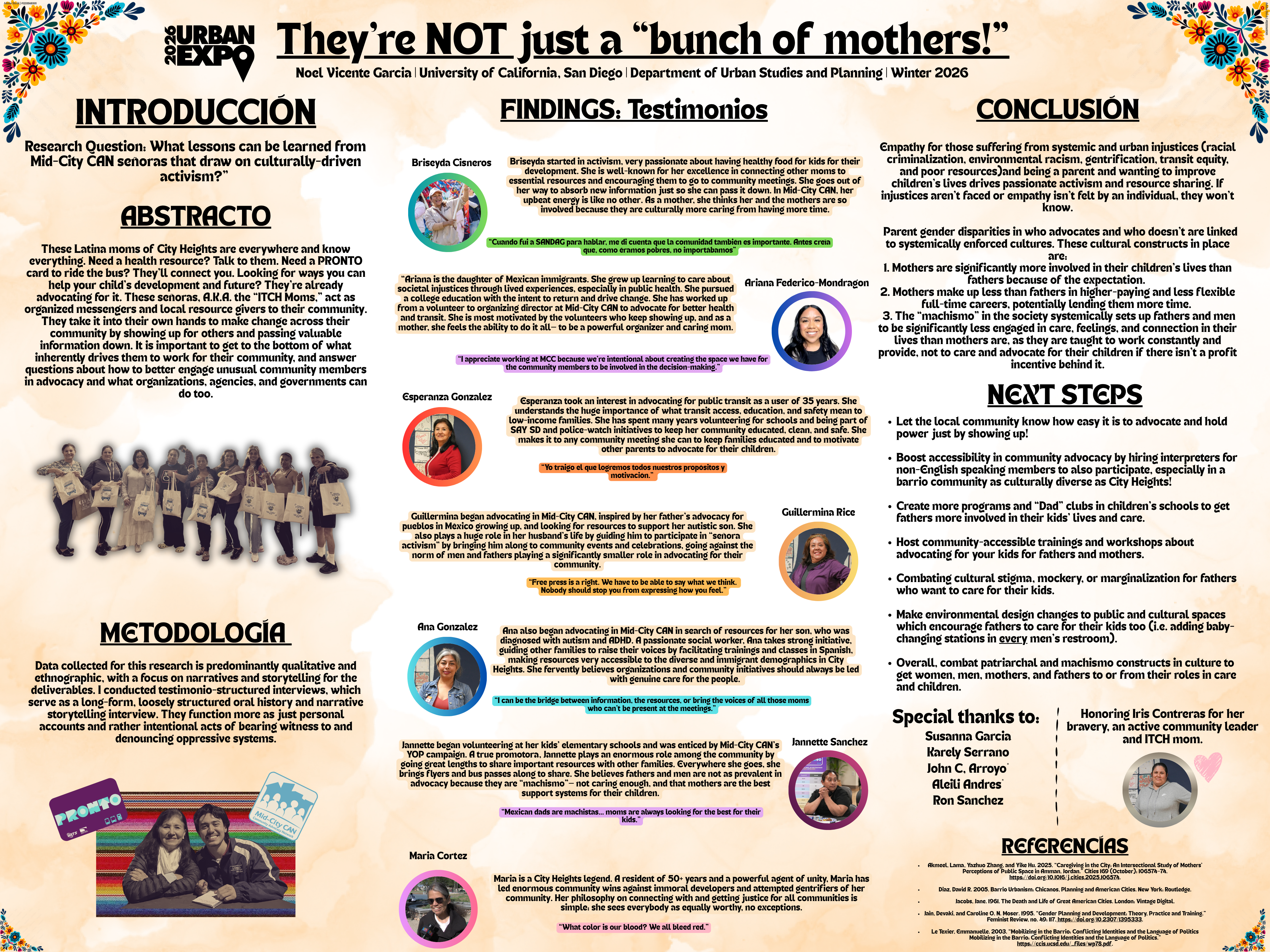
Mid-City CAN is proud to highlight Improving Transportation in City Heights (ITCH) and Youth Justice Momentum Team volunteer Noel Vicente Garcia's project that he debuted at the 2026 Urban Expo held in La Jolla.
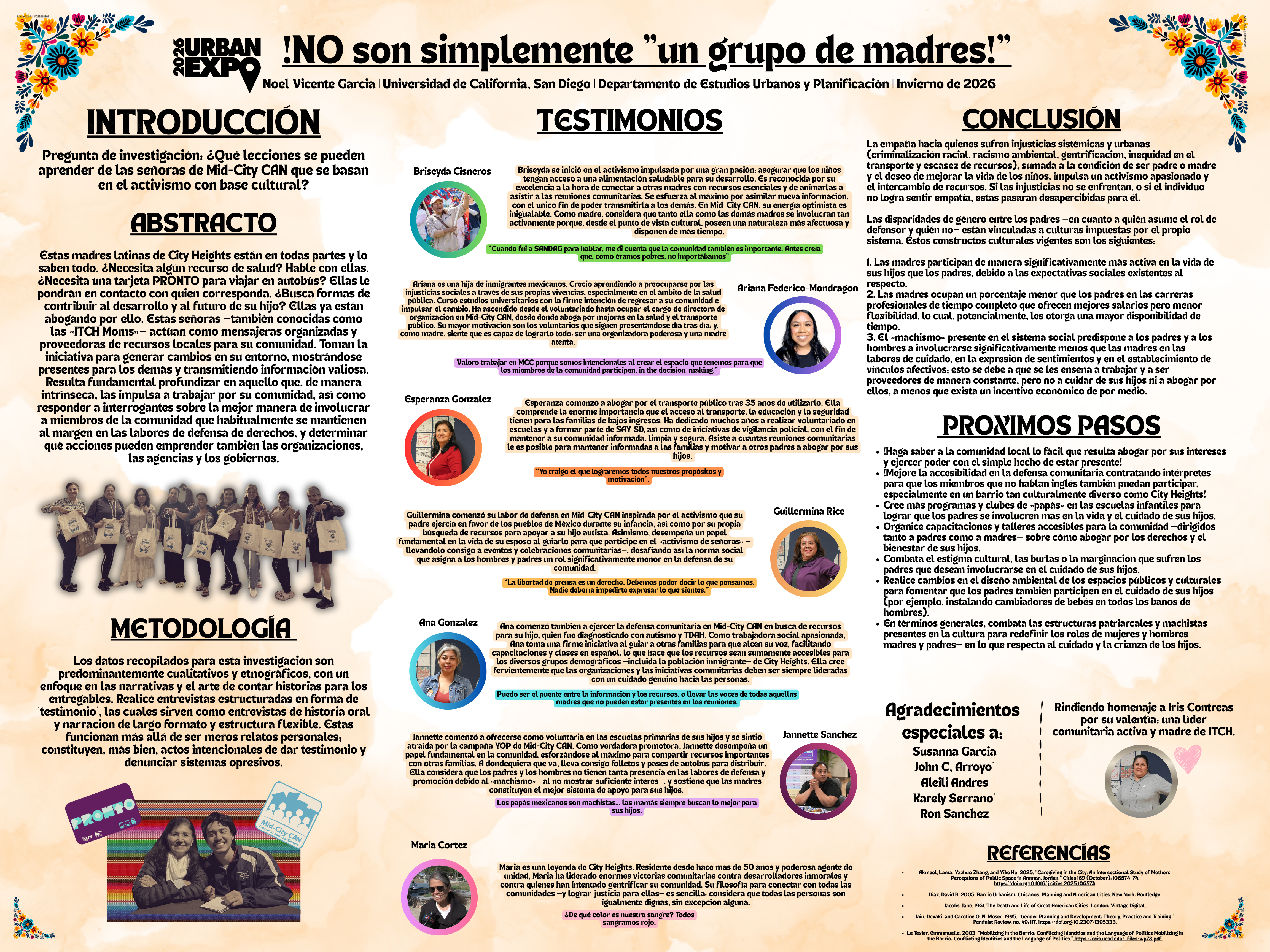
They're NOT just a “bunch of mothers!"
Valuable Lessons about Culturally-Driven Activism in City Heights
By Noel Vicente Garcia | University of California, San Diego | Department of Urban Studies and Planning | Winter 2026
INTRODUCCIÓN
Research Question: "What lessons can be learned from Mid-City CAN señoras that draw on culturally-driven activism?”
ABSTRACT
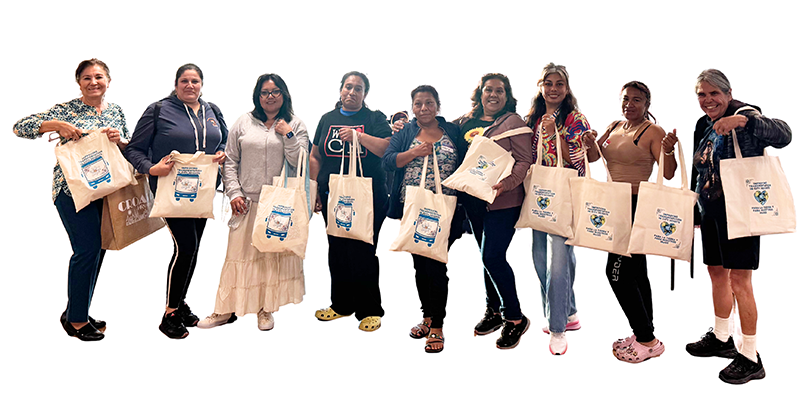
These Latina moms of City Heights are everywhere and know everything. Need a health resource? Talk to them. Need a PRONTO card to ride the bus? They’ll connect you. Looking for ways you can help your child’s development and future? They’re already advocating for it. These señoras, A.K.A. the “ITCH Moms,” act as organized messengers and local resource givers to their community. They take it into their own hands to make change across their community by showing up for others and passing valuable information down. It is important to get to the bottom of what inherently drives them to work for their community, and answer questions about how to better engage unusual community members in advocacy and what organizations, agencies, and governments can do too.
METHODOLOGY
Data collected for this research is predominantly qualitative and ethnographic, with a focus on narratives and storytelling for the deliverables. I conducted testimonio-structured interviews, which serve as a long-form, loosely structured oral history and narrative storytelling interview. They function more as just personal accounts and rather intentional acts of bearing witness to and denouncing oppressive systems.
TESTIMONIOS
Briseyda Cisneros
- Briseyda started in activism, very passionate about having healthy food for kids for their development. She is well-known for her excellence in connecting other moms to essential resources and encouraging them to go to community meetings. She goes out of her way to absorb new information just so she can pass it down. In Mid-City CAN, her upbeat energy is like no other. As a mother, she thinks her and the mothers are so involved because they are culturally more caring from having more time.
- QUOTE: “Cuando fui a SANDAG para hablar, me di cuenta que la comunidad también es importante. Antes creía que, como éramos pobres, no importábamos”
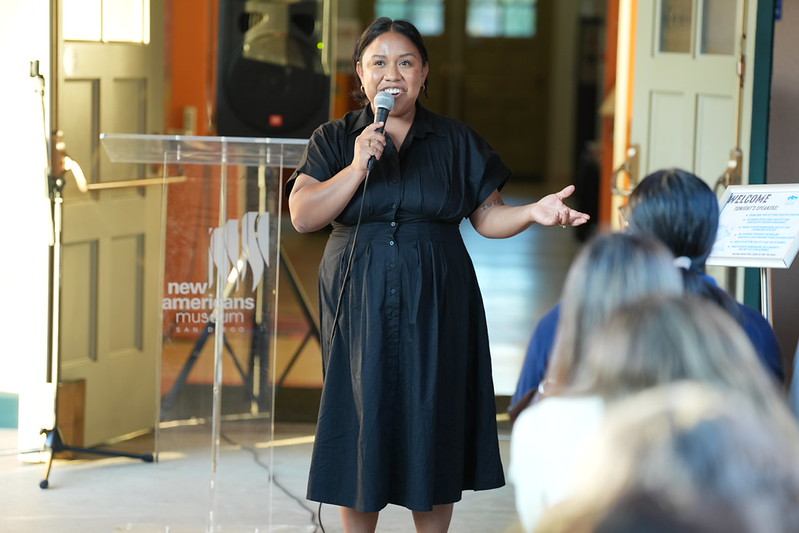
Ariana Federico-Mondragon
- Ariana is the daughter of Mexican immigrants. She grew up learning to care about societal injustices through lived experiences, especially in public health. She pursued a college education with the intent to return and drive change. She has worked up from a volunteer to organizing director at Mid-City CAN to advocate for better health and transit. She is most motivated by the volunteers who keep showing up, and as a mother, she feels the ability to do it all— to be a powerful organizer and caring mom.
- QUOTE: “I appreciate working at MCC because we’re intentional about creating the space we have for the community members to be involved in the decision-making.”
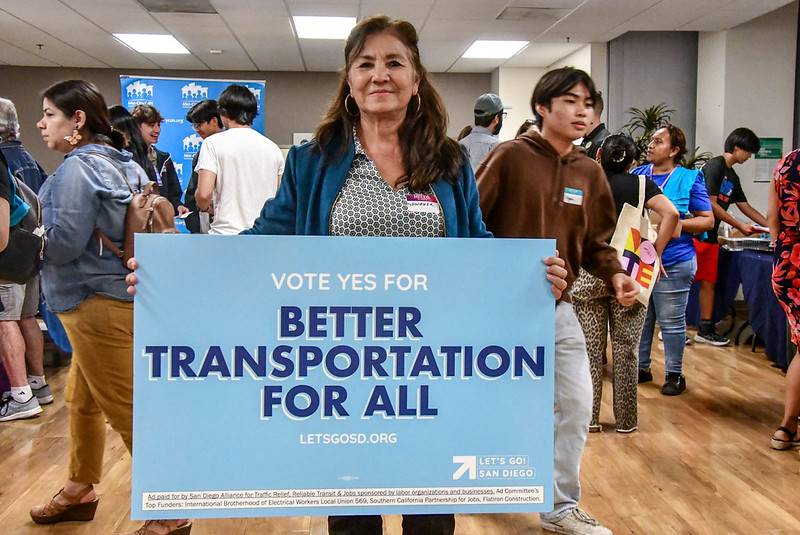
Esperanza Gonzalez
- Esperanza took an interest in advocating for public transit as a user of 35 years. She understands the huge importance of what transit access, education, and safety mean to low-income families. She has spent many years volunteering for schools and being part of SAY SD and police-watch initiatives to keep her community educated, clean, and safe. She makes it to any community meeting she can to keep families educated and to motivate other parents to advocate for their children.
- QUOTE: “Yo traigo el que logremos todos nuestros propósitos y motivación.”
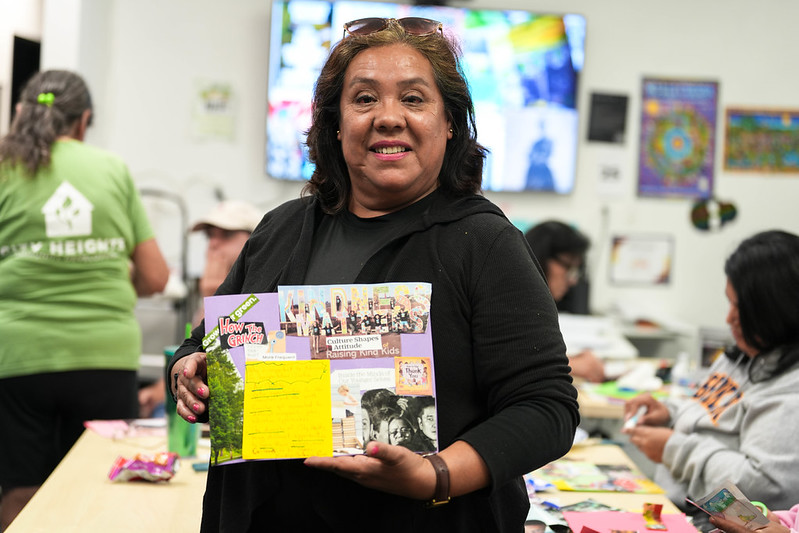
Guillermina Rice
- Guillermina began advocating in Mid-City CAN, inspired by her father’s advocacy for pueblos in México growing up, and looking for resources to support her autistic son. She also plays a huge role in her husband’s life by guiding him to participate in “señora activism” by bringing him along to community events and celebrations, going against the norm of men and fathers playing a significantly smaller role in advocating for their community.
- QUOTE: “Free press is a right. We have to be able to say what we think. Nobody should stop you from expressing how you feel.”
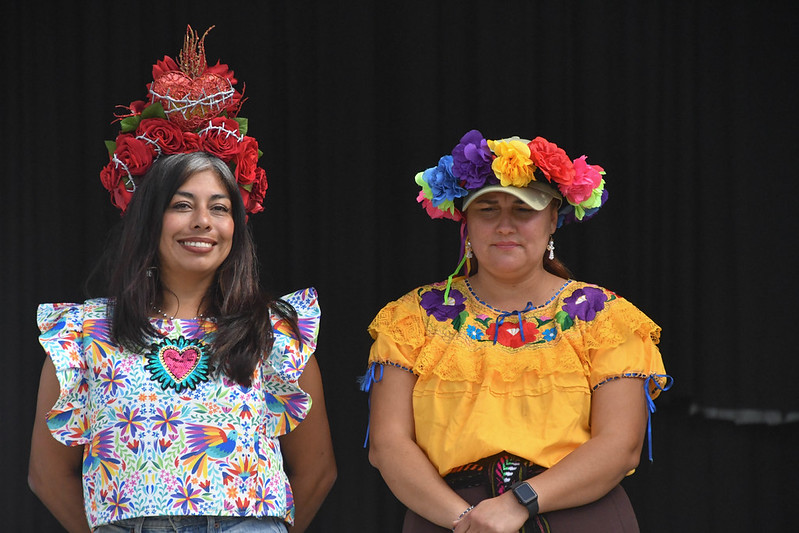
Ana Gonzalez
- Ana also began advocating in Mid-City CAN in search of resources for her son, who was diagnosed with autism and ADHD. A passionate social worker, Ana takes strong initiative, guiding other families to raise their voices by facilitating trainings and classes in Spanish, making resources very accessible to the diverse and immigrant demographics in City Heights. She fervently believes organizations and community initiatives should always be led with genuine care for the people.
- QUOTE: “I can be the bridge between information, the resources, or bring the voices of all those moms who can’t be present at the meetings.”
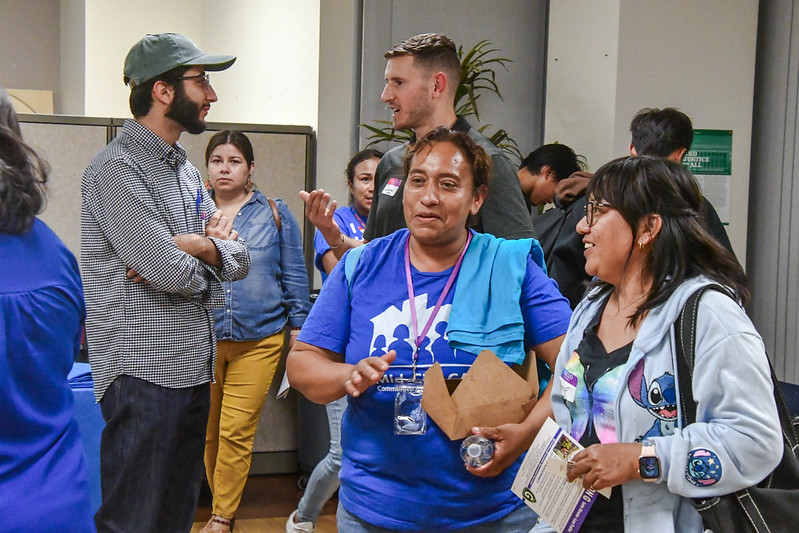
Jannette Sanchez
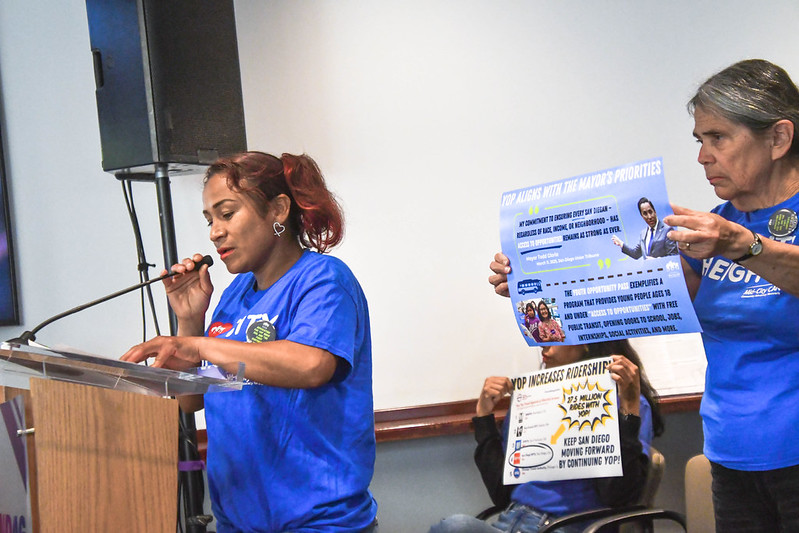
- Jannette began volunteering at her kids’ elementary schools and was enticed by Mid-City CAN’s YOP campaign. A true promotora, Jannette plays an enormous role among the community by going great lengths to share important resources with other families. Everywhere she goes, she brings flyers and bus passes along to share. She believes fathers and men are not as prevalent in advocacy because they are “machismo”— not caring enough, and that mothers are the best support systems for their children.
- QUOTE: “Mexican dads are machistas… moms are always looking for the best for their kids.”
Maria Cortez
- Maria is a City Heights legend. A resident of 50+ years and a powerful agent of unity, Maria has led enormous community wins against immoral developers and attempted gentrifiers of her community. Her philosophy on connecting with and getting justice for all communities is simple: she sees everybody as equally worthy, no exceptions.
- QUOTE: “What color is our blood? We all bleed red.”
CONCLUSION
Empathy for those suffering from systemic and urban injustices (racial criminalization, environmental racism, gentrification, transit equity, and poor resources)and being a parent and wanting to improve children’s lives drives passionate activism and resource sharing. If injustices aren’t faced or empathy isn’t felt by an individual, they won’t know.
Parent gender disparities in who advocates and who doesn’t are linked to systemically enforced cultures. These cultural constructs in place are:
- Mothers are significantly more involved in their children’s lives than fathers because of the expectation.
- Mothers make up less than fathers in higher-paying and less flexible full-time careers, potentially lending them more time.
- The “machismo” in the society systemically sets up fathers and men to be significantly less engaged in care, feelings, and connection in their lives than mothers are, as they are taught to work constantly and provide, not to care and advocate for their children if there isn’t a profit incentive behind it.
NEXT STEPS
- Let the local community know how easy it is to advocate and hold power just by showing up!
- Boost accessibility in community advocacy by hiring interpreters for non-English speaking members to also participate, especially in a barrio community as culturally diverse as City Heights!
- Create more programs and “Dad” clubs in children’s schools to get fathers more involved in their kids’ lives and care.
- Host community-accessible trainings and workshops about advocating for your kids for fathers and mothers.
- Combating cultural stigma, mockery, or marginalization for fathers who want to care for their kids.
- Make environmental design changes to public and cultural spaces which encourage fathers to care for their kids too (i.e., adding baby-changing stations in every men’s restroom).
- Overall, combat patriarchal and machismo constructs in culture to get women, men, mothers, and fathers to or from their roles in care and children.
SPECIAL THANKS TO
Karely Serrano, John C, Arroyo, Aleili Andres, Ron Sanchez, Natalia Robles, Pablo Dollero, Guadalupe Rojas, Victor Ponce, Isaac Martin, and Susanna Garcia.
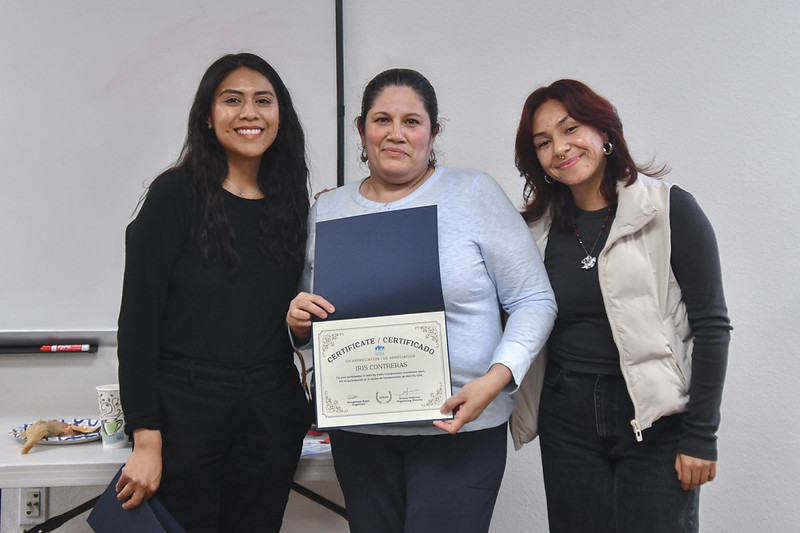
*Honoring Iris Contreras for her bravery, an active community leader and ITCH mom.*
REfERENCÍAS
- Akmeel, Lama, Yazhuo Zhang, and Yike Hu. 2025. “Caregiving in the City: An Intersectional Study of Mothers’ Perceptions of Public Space in Amman, Jordan.” Cities 169 (October): 106574–74. https://doi.org/10.1016/j.cities.2025.106574.
- Diaz, David R. 2005. Barrio Urbanism: Chicanos, Planning and American Cities. New York: Routledge.
- Jacobs, Jane. 1961. The Death and Life of Great American Cities. London: Vintage Digital.
- Jain, Devaki, and Caroline O. N. Moser. 1995. “Gender Planning and Development: Theory, Practice and Training.” Feminist Review, no. 49: 117. https://doi.org/10.2307/1395333.
- Le Texier, Emmanuelle. 2003. “Mobilizing in the Barrio: Conflicting Identities and the Language of Politics Mobilizing in the Barrio: Conflicting Identities and the Language of Politics.” https://ccis.ucsd.edu/_files/wp78.pdf.
Be the first to comment
Sign in with